Project case study
Transforming hospital delivery through multitrade prefabrication
The Miami Valley Hospital Southeast Addition shows how large-scale, multi-trade prefabrication can improve safety, accelerate delivery and reduce costs. Through early coordination and off-site assembly, our project team reimagined how complex healthcare facilities can be built more efficiently.
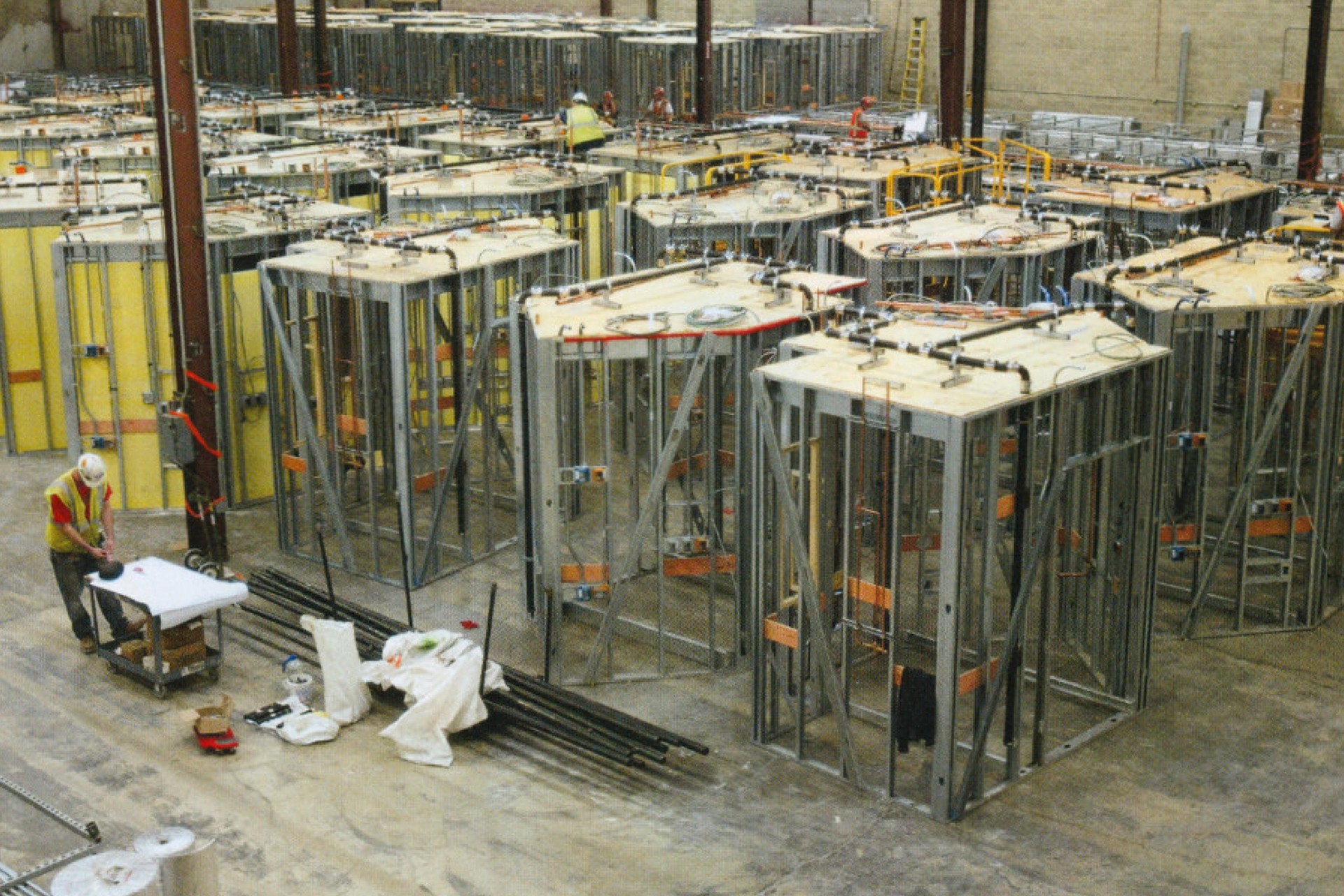
Delivering complex healthcare environments requires precision, speed and an unwavering focus on safety. For the Miami Valley Hospital Southeast Addition in Dayton, Ohio, the project team adopted multi-trade prefabrication to fundamentally change how hospital components were designed, assembled and installed.
The 12-story, 484,000-square-foot hospital addition was delivered by a joint venture led by Skanska in close collaboration with the owner and design partners. During design development, the team identified an opportunity to prefabricate major building systems offsite in a controlled warehouse environment. Mechanical, electrical, plumbing (MEP), drywall, and other trades collaborated to preassemble 178 identical patient rooms, 120 overhead corridor utility racks, bathroom pods and headwalls.
This approach transformed both safety and productivity. Work traditionally performed at height was completed at bench level, reducing risk and improving working conditions. Prefabrication was completed with zero injuries, while onsite installation became faster, more predictable and highly repeatable. Entire patient floors were roughed in within weeks instead of months.
Multi-trade prefabrication also delivered measurable schedule and cost benefits. Despite an early delay caused by unforeseen soil conditions, this strategy helped the team recover lost time—cutting more than two months from the construction schedule and reducing overall project costs by an estimated one to two percent. Productivity gains were substantial, with certain trade activities completed several times faster than traditional site-based work.
Early coordination and design decision-making were critical to success. Full-scale mockups and detailed building information modeling allowed the team, end users and regulatory agencies to validate layouts and system integration before production began. Standardized, “same-handed” patient rooms further supported efficiency, quality and long-term maintenance consistency.
The Miami Valley Hospital Southeast Addition demonstrates how large-scale, multi-trade prefabrication can be successfully applied to complex healthcare facilities. This project not only improved safety and predictability during construction, but also provided a repeatable model for delivering hospitals faster, smarter and with greater confidence—reshaping expectations for hospital construction across the industry.
Categories