Press release
Skanska receives $294,100 U.S. Forest Service Wood Innovation Grant to advance mass timber risk mitigation and insurance guidance
Working in open collaboration with insurance carriers and brokers, Skanska-led team will develop Tall Mass Timber Builders Risk Insurance Case Study and Project Guide to strengthen water and fire mitigation plans, builders risk applications and post-occupancy guidance for mass timber buildings
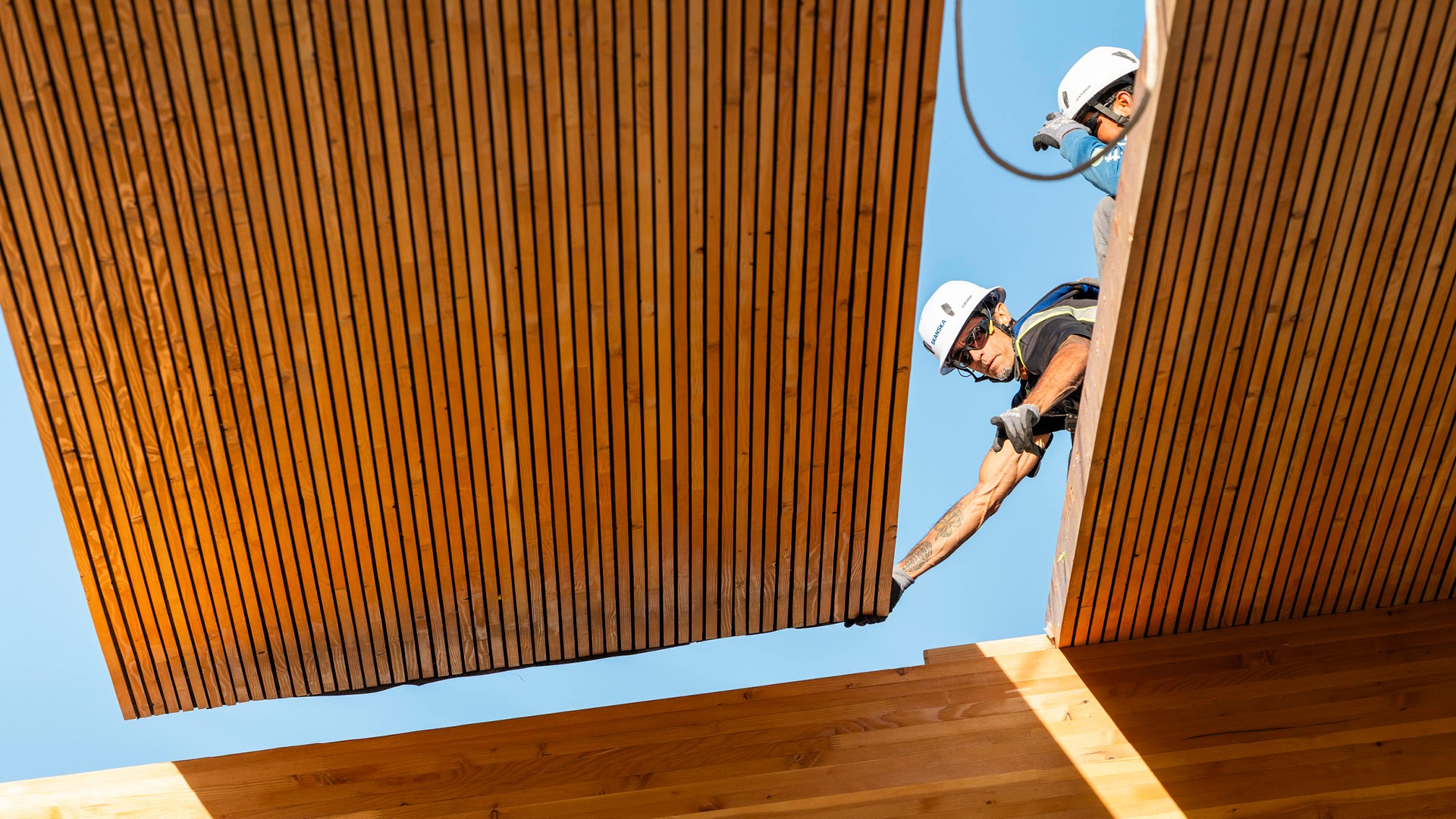
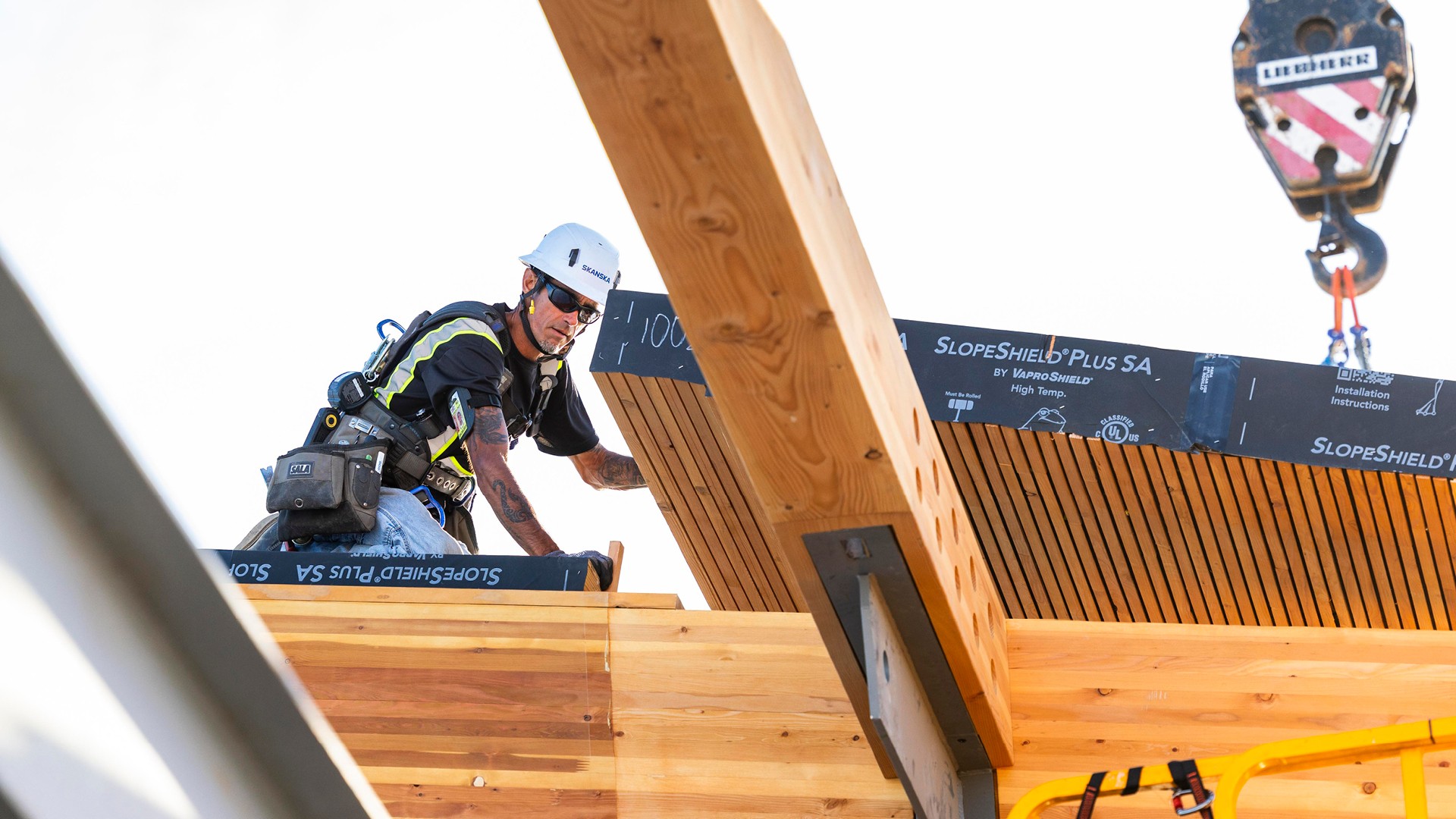
Seattle, WA – Skanska, a leading construction and development firm, has received a $294,100 Wood Innovation Grant from the U.S. Forest Service. The grant, for the “Tall Mass Timber Insurance Case Study & Project Guide,” covers a 2.5-year program designed to advance the mass timber industry by addressing critical knowledge gaps related to insurance for mid- and high-rise mass timber buildings.
“Today, the cost of builders risk insurance is significantly greater for mass timber projects than those with traditional building materials, and that’s impacting the ability to move forward with many mass timber projects,” said Dean Lewis, director of mass timber and prefabrication, Skanska USA Building. “That higher cost is driven by the misunderstanding of risk exposure of mass timber vs. traditional building materials, and this grant will allow us to develop a case study and guide to help inform and hopefully recalibrate the entire industry.”
Multiple industry reports and Skanska's own experience found that builders risk insurance for mass timber can be 25 to 65 percent higher than traditional concrete and steel construction. While costs are depended on project location and duration, a general industry baseline for conventional concrete or steel mid-rise buildings is 0.25-0.40 percent of total construction cost, whereas Type IV mass timber projects can run 0.45–0.80 percent depending on scope, size, location, duration, and the project team. For a $100 million Type IV mass timber project, this typically equates to $250,000 to $400,000 for a concrete/steel builders risk policy, while insurance for the same project using mass timber can run $450,000 to $800,000.
Although building codes now permit taller and more exposed mass timber construction, the gap between code acceptance and insurance readiness introduces late‑stage financial risk. This project will address this challenge by bringing together experienced mass timber professionals and industry partners to create standardized, insurer‑ready documentation and tools that reduce underwriting uncertainty, improve premium predictability, and enable repeatable mass timber project delivery, thereby unlocking durable expansion of wood products markets. Through their collaboration, the resulting work will provide a transparent, practical framework for managing insurance-related risk on the new Type IV-A, -B, and -C construction types.
The Skanska-led team will use the Forest Service grant in conjunction with an existing mass timber project currently in the final stages of design and permitting to build a large-scale Type IV-B office projects on the west coast.
The final deliverable will be a guide for the industry, shared through WoodWorks, that helps owners, designers, contractors, lenders, and insurers better understand the insurance process and reduce financial barriers to broader adoption of mass timber construction.
“We are so thankful to the Forest Service and USDA for this grant,” added Lewis. “Their funding is instrumental in our ability to help move this industry forward and continue to grow the use of wood and wood products in construction.”
Project team members include Skanska USA Building, Gallagher Insurance Brokers, Holmes Engineering & Holmes Fire, Mithun, Waugh Thistleton Architects, and Woodworks.
The U.S. Forest Service, an agency of the U.S. Department of Agriculture, announced $105.5 million in Wood Innovation Grants covering 177 projects in 2026. The Wood Innovations Grant Program invests in proposals that expand traditional wood utilization projects, promote using wood as a construction material in commercial, institutional and multifamily buildings, and expand wood energy markets. Healthy forests depend on a healthy forest products economy, and these investments support local economies while directly contributing to improving forest health and lowering wildfire risks to communities.
Contact

West
Daniela Arellano
Communications Director