Press release
Skanska's building operations releases Spring 2026 Market Trends Report, highlighting cost pressures and tech-driven growth
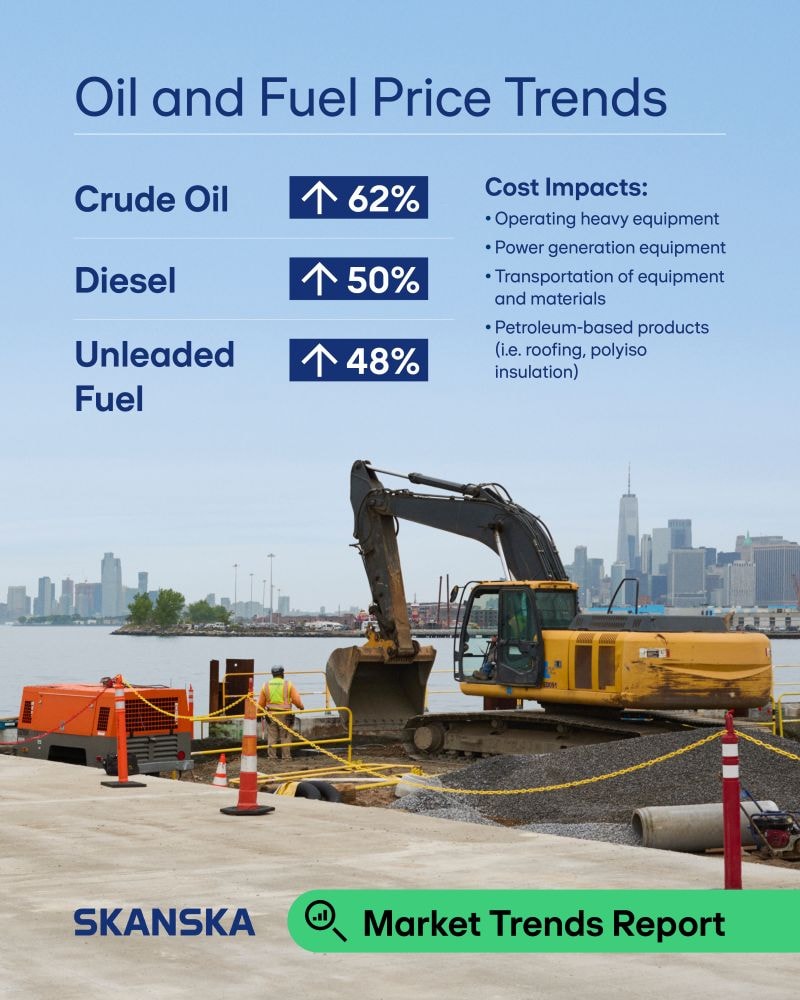
NEW YORK, NY – Skanska, a leading global construction and project development firm, has released its Spring 2026 Construction Market Trends Report. The report examines evolving construction market conditions, including construction cost escalation and labor market trends and the continued influence of high-growth sectors such as data centers, life sciences and advanced technology infrastructure.
“As the construction industry moves further into 2026, market conditions remain uneven across sectors, with technology-driven projects continuing to outpace more traditional commercial and residential activity,” said Steve Stouthamer, Executive Vice President of Project Planning at Skanska USA Building. “While planning activity is showing signs of improvement, tariff uncertainty, rising material costs and continued labor market demand pressures across key MEP trades remain significant challenges for owners and contractors alike.”
Different U.S. regions are also experiencing unevenness. While many sectors are feeling the high tech and life sciences demands with significant labor resource challenges, others have seen traditional commercial markets buoyed by high interest rates and shifting policy changes.
With experience across diverse sectors nationwide and globally, Skanska brings a unique perspective on emerging industry trends, with key report highlights including:
- The labor market indices remained relatively stable despite ongoing hiring challenges across the industry and demands in high tech craft labor:
- In April, the construction industry added 9,000 net new jobs, including 19,000 positions in nonresidential construction.
- Construction employment increased by 50,000 jobs year-over-year, representing a 0.6-percent gain, while nonresidential employment rose 2.0 percent, driven largely by continued growth in data center construction spending.
- Macroeconomic and energy volatility continue to drive broad-based construction cost escalation across the supply chain:
- The conflict in Iran and disruptions in the Strait of Hormuz are driving energy volatility, with oil prices up more than 40 percent, Brent Crude exceeding $119 per barrel, and roughly 20 percent of global oil flows disrupted, increasing fuel, transportation and material costs across the supply chain.
- The ENR Materials Index increased 5.3 percent over the 12-month period ending May 2026, driven in part by tariffs and inflationary pressures.
- Skanska’s Composite Cost Index rose more than 6 percent year-over-year, driven by double digit MEP trade escalation due to strong demand in data center and life science markets.
- Regional markets are experiencing escalation levels differently depending on the extent of high tech development in their locations.
- Demand for electrification, high tech sector volume, and AI-related infrastructure continues to place upward pressure on key commodities and fabricated materials.
- Materials and metals markets remain highly dynamic:
- Metal prices continue to rise across nearly all categories, driven by electrification, AI-related demand and the closure of the Strait of Hormuz, which has especially impacted aluminum markets.
- Nickel is currently trending at $19.4K per ton, up 26.5 percent over the past 12 months.
- Copper is currently priced at $5.93 per pound, up 29.5 percent year over year.
- Aluminum is currently priced at $3.5K per ton, up 45.3 percent over the past 12 months.
- Structural steel prices also continue to climb amid strong demand from data centers and large-scale manufacturing projects. Cold-rolled coil is currently priced at $1.22, reflecting a 25.3 percent increase over the past 12 months.
- Architectural and preconstruction indicators present mixed but improving signals:
- The Architecture Billings Index (ABI) rose to 49.8 in March, with project inquiries and backlog levels increased.
- Institutional and commercial/industrial sectors posted the strongest ABI gains, while the Northeast region remained softer overall.
- Sector performance continues to be shaped by technology and infrastructure investment:
- Data centers and technology-related megaprojects continue to drive construction employment growth and MEP pricing escalation.
- Markets with significant data center and life science development are experiencing higher trade pricing.
- Total construction starts were up 12.8 percent in March 2026 to a seasonally adjusted annual rate of $1.22 trillion, driven mainly by a 37.9 percent jump in nonbuilding construction.
- Project stress indicators are signaling continued caution in the market
- The Project Stress Index (PSI) increased to 104.6 in March, reflecting a 4.2 percent month-over-month increase from February.
- While the March PSI remains below notable spikes recorded in late 2025, the index suggests ongoing challenges tied to delayed bid dates, on-hold projects and preconstruction abandonment.
- Compared to March 2025, the PSI declined 3.5 percent, while bid date delays rose 7.8 percent year-over-year.
On Thursday, June 4, Skanska will host a public webinar, “Data Centers Get the Headlines While Life Sciences are Quietly Booming,” where Skanska leaders and industry experts will discuss the macroeconomic and sector trends shaping construction costs, labor availability, material pricing and sector activity across the U.S. construction market. Learn more and register HERE.