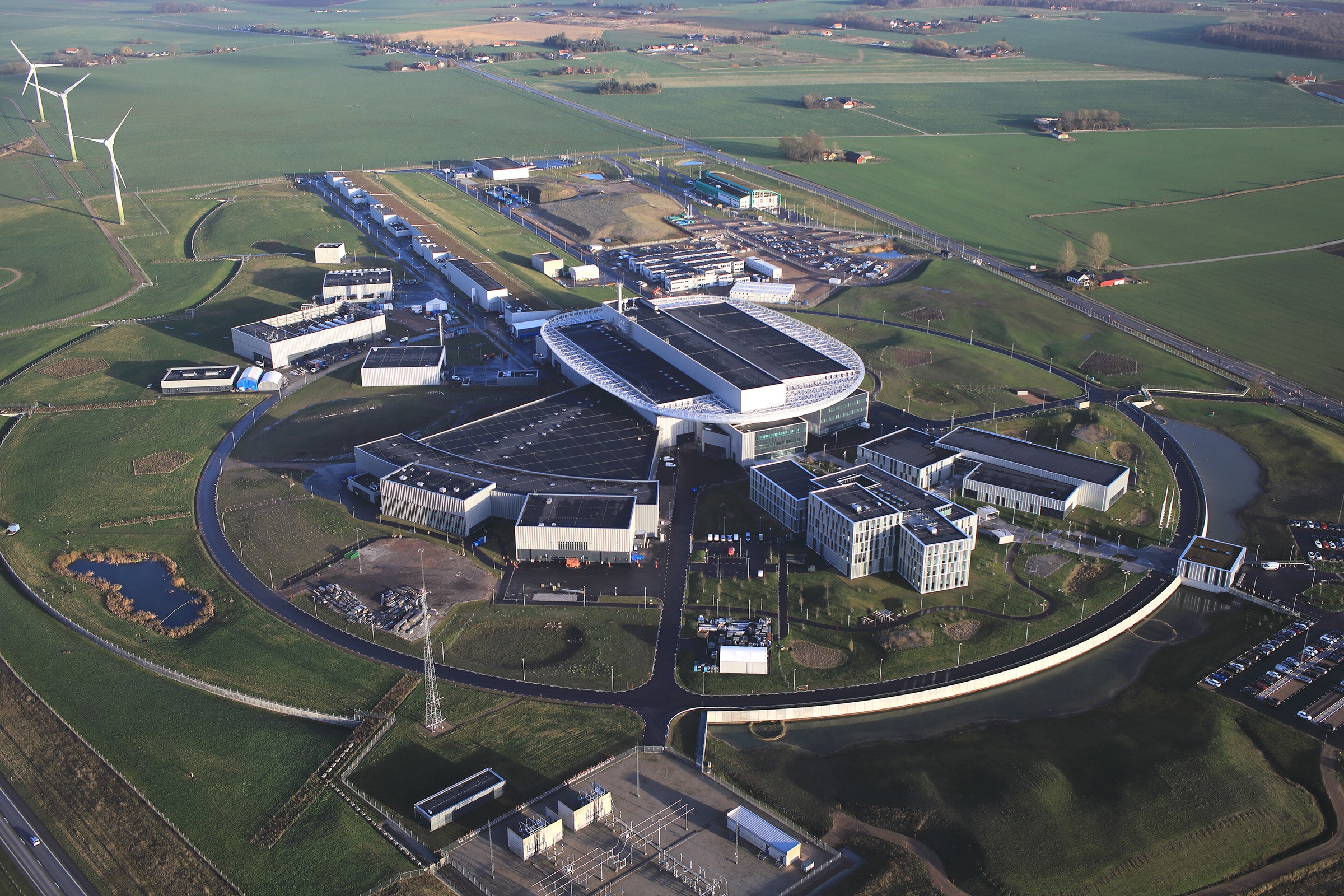
In December 2020, the research facility was 75 percent complete.
Flight scanning of the ESS site, July 2017
Flight scanning of the ESS site, 1st of November 2016
Installation of bored piles for the ESS Target station.
Casting of the first part of the ESS Target station bottom slab. This 400 mm slab will be followed by another 1600 mm bottom slab.
Reinforcement for the 400 mm bottom slab in the ESS Target station.
Floor casting in the ESS Klystron Gallery.
The Cryo Building, where large compressors will cool down helium gas, to be fed into the ESS accelerator tunnel making it superconductive.
Facades on the 489 meter long Gallery Building that stretches all the way along the Accelerator tunnel giving it the acceleration power needed.
Inside the Front End Building at ESS.
The Loading Hall in the Klystron Gallery, containing an overhead crane for lifting heavy equipment.
Cold Box in the Klystron Gallery, here an enormous fridge will cool down Helium from 4k to 2K (-271 degrees Celsius).
Overview of the ESS Target, Monolith. In the middle a rotating wheel made of Tungsten will be installed, and this is where spallation occurs.
Piling for the Beam Line Gallery, rows of neutron guides streaming out towards the experimental halls.
Refill of the ESS Accelerator tunnel, which will be hidden under a 5-7 meter high reinforced slope.
Reinforcement for the 1600 mm bottom slab for the ESS Target station.
Steel structure for the ESS Klystron Gallery.
Aerial image of the ESS construction site in June 2017. Photo: Perry Nordeng / ESS.
Cold Box located in the Klystron Gallery at ESS in Lund, Sweden. This is where the helium gas is cooled down to very low temperature before it enters the accelerator where the final cooling to 2 Kelvin (-271O C) takes place inside cryomodules.
The Cryo Building at ESS in Lund, contains compressors for helium gas, stored in large outdoor tanks. The helium gas is cooled down to 2 Kelvin (K) and then transforms into liquid form, making the accelerator tunnel superconductive.
The bunker of the Target Building at ESS in Lund, with the concrete structure where the Monolith is to be placed. This is where spallation will occur.
The ESS accelerator tunnel roof is underground and covered by a five-meter thick layer of soil where grass is sown.